

The Centre sought US$99 million over oilfield costs. The awards left nothing further due on the disputed item. The Delhi High Court’s reasons explain why India enforced them and what GIMAC can learn.
The Ravva arbitration awards remain enforceable in India. On 2 November 2026, the Supreme Court dismissed the Centre’s special leave petition against Vedanta and Ravva Oil. The Centre had sought US$99 million from the companies. The final award, however, found that they owed nothing further on that claim. The Supreme Court therefore made no fresh payment order.
By Deepshikha Singh, Advocate, DSLA for GIM&AC
Critical Analysis Revised 3 November 2026
Supreme Court order of 2 November 2026, reproduced by Indian Kanoon · Delhi High Court judgment of 1 July 2026
What started the ONGC carry dispute at the Ravva oilfield?
In October 1994, India signed a production-sharing contract with ONGC, Videocon Petroleum, Ravva Oil and Command Petroleum. Together, they agreed to develop the offshore Ravva oilfield in the Krishna–Godavari Basin. Command later became Cairn Energy India. Vedanta later acquired its interest through an assignment and a merger.
Under Article 3.3, the private companies agreed to pay certain costs that ONGC would otherwise have borne. Once the contractors recovered allowable costs, the Centre shared in the remaining oil, known as “profit petroleum”. Its share depended on the companies’ post-tax rate of return. The Ravva arbitration awards therefore turned on which costs the companies could count when calculating that return. Could they include what they had paid on ONGC’s behalf?
The tribunal majority agreed that those payments counted. The Centre, however, argued that including those costs reduced its share of the oil. Consequently, a dispute over one accounting entry became a contest over the Centre’s claim to US$99 million. Delhi High Court, paragraphs 6–14 and 78–88.
How did the Ravva oilfield awards reach the Indian courts?
| Date | What happened | Why it mattered |
|---|---|---|
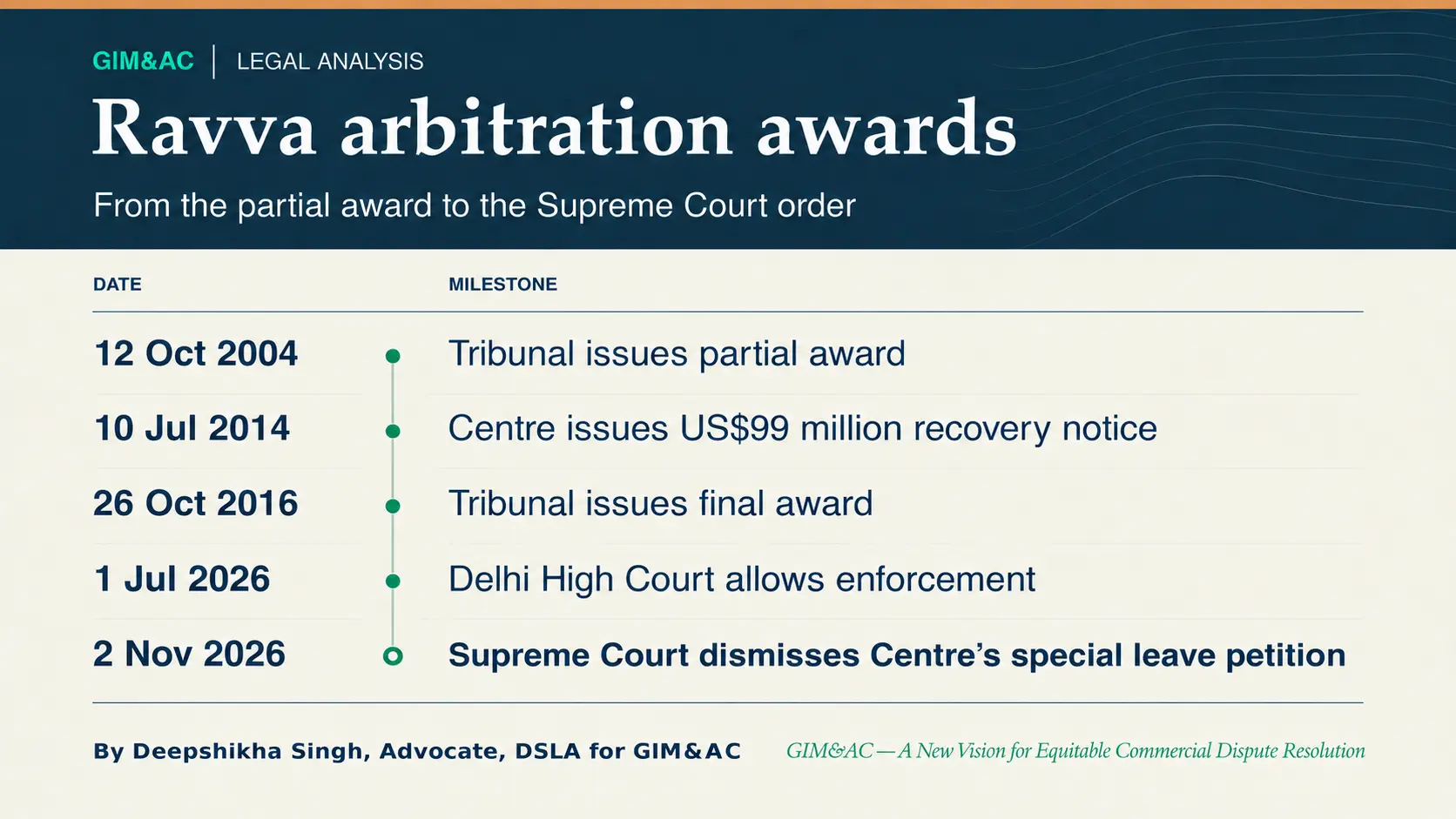
| 12 Oct 2004 | The Kuala Lumpur tribunal issued a partial award. | The Centre won four of six issues, so the companies paid the amounts due on those four with interest. The tribunal, however, left the disputed calculation open. |
| 2009–11 | A Malaysian court set aside the partial award, but the Court of Appeal restored it. | Malaysia’s Federal Court then upheld the award on 11 October 2011. |
| 10 Jul 2014 | The Centre sought US$64 million from Cairn and US$35 million from Ravva Oil. | It proposed recovery from oil-sale proceeds. The notice later determined when the enforcement clock started on these facts. |
| 26 Oct 2016 | The reconstituted tribunal issued its final award. | It found no further sum due from the companies on the carry issue. |
| May 2017–Feb 2019 | The companies sought enforcement in Delhi in May 2017. | Meanwhile, the Malaysian challenge to the final award ended on 28 February 2019. |
| 17 Nov 2025 | The Supreme Court sought an undertaking to protect the Centre’s security. | It also directed the High Court to conclude the enforcement proceedings within two months. |
| 1 Jul–2 Nov 2026 | The Delhi High Court allowed enforcement. The Supreme Court then refused leave to appeal. | The July direction to release the companies’ guarantees within eight weeks therefore stood. |
Delhi High Court, paragraphs 9–14, 68 and 101–102 · Supreme Court interim order of 17 November 2025 · Vedanta Resources disclosure on the final award.
Why did the Delhi High Court allow enforcement of the Ravva awards?
Justices J.B. Pardiwala and Manmohan heard Government of India v. Vedanta Ltd. & Anr., SLP(C) No. 36277/2026. They dismissed the petition because they found no error warranting interference (paragraphs 2–3). The detailed findings below therefore belong to Justice Jasmeet Singh’s Delhi High Court judgment, 2026:DHC:5268. Supreme Court’s written order · High Court’s reasons.
Which objections did the High Court reject?
| Issue | What the High Court decided | Paragraphs |
|---|---|---|
| Was the enforcement petition too late? | The May 2017 petition was timely because Article 137 allows three years from the date the right to apply arises. In this case, that period began in July 2014, when the Centre sought to recover amounts the companies had already adjusted. | 65–71 |
| Could the court recalculate the Centre’s share? | The majority read Article 3.3 together with Article 16 and Appendix D. Because that reading was plausible, Section 48 gave the court no ground to substitute its own interpretation. | 72–83 |
| Did control over natural resources justify refusal? | The Centre showed a dispute over contract costs. It did not, however, establish a breach of fundamental Indian policy or of the most basic notions of justice or morality. | 84–91 |
| Had the tribunal’s mandate expired? | The parties had six months to agree on the amount. When that period ended, the tribunal still had authority to decide the question because it had reserved it and kept the proceedings open. | 92–95 |
| Did the final award exceed the reference? | Under paragraph 4(b) of the agreed terms, the tribunal could decide the amount if negotiations failed. It did so while leaving the legality of the recovery notice outside its decision. | 96–99 |
The High Court therefore declared the Ravva arbitration awards enforceable. It also ordered the release of the companies’ bank guarantees within eight weeks of its July judgment. However, the court records cited here do not give the actual release date. Operative directions, paragraphs 100–102.
Why GIM&AC is reporting on the Ravva arbitration awards
The Centre had a legitimate interest in protecting oil revenue. Indeed, the companies paid interest on the issues the Centre won. The court also protected the government’s security while the Indian proceedings were pending. By the final stage, however, the government needed a ground under Section 48 to resist enforcement. In other words, disagreement over the payment formula alone could not justify a fresh hearing on the merits.
In Delhi, proceedings to enforce the Ravva arbitration awards lasted more than nine years, from May 2017 to July 2026. That wait can cost a company money even when it defeats the underlying claim. For example, a bank guarantee can tie up credit while enforcement proceedings continue. The judges reportedly questioned how such delays affect confidence in arbitration. Their written order, however, addresses only the decision on leave. Interim security order · Hearing coverage of the oral remarks.
A related Indian case illustrates why delays can continue even after an award holder turns to the courts. In Royal Construction, the Supreme Court sought a Law Commission study while leaving genuine payment adjustments to the executing court. ABC Live’s analysis of arbitral award enforcement delays.
What can GIM&AC at GIFT City learn from the Ravva oilfield awards?
For the Gandhinagar International Mediation & Arbitration Centre (GIM&AC), the Ravva arbitration awards illustrate why the terms of reference matter. The first award settled how to treat the ONGC costs but left the amount open. Because the parties agreed the tribunal could decide that amount if negotiations failed, the High Court could trace its authority years later.
For example, consider an infrastructure claim. A GIM&AC tribunal might decide that a contractor qualifies for a price adjustment while leaving the amount open. In that case, the partial award should identify the clause, the calculation still outstanding, and the time allowed for agreement. The tribunal should also identify any statutory question outside its remit, as the Ravva tribunal did with the recovery notice. Crucially, it should say how either party can return to the tribunal if negotiations fail, subject to applicable mandate limits.
Which law governs a GIM&AC-administered award?
If the legal seat is Gandhinagar, India, Part I of the Arbitration and Conciliation Act applies. Section 34 governs an application to set the award aside, while Section 36 governs enforcement in India. Even before the final award, a party can challenge a partial award under Section 34 if it conclusively decides a distinct issue. Therefore, parties should record delivery of each such award and assess its deadline separately. Supreme Court in IFFCO v. Bhadra Products, paragraph 16.
In contrast, Sections 47–49 govern Indian enforcement of a foreign-seated award that qualifies under Section 44. Section 47 sets out the documents an applicant must produce, while Section 48 lists the grounds for refusing enforcement. Once the court finds the award enforceable, Section 49 treats it as a decree of that court. The legal seat matters even if GIM&AC administers the case or hosts a hearing at GIFT City: arbitration and Conciliation Act, Parts I and II.
Which award records should GIM&AC preserve?
GIM&AC describes BRAS 2.0 as a system for traceable award records. In practice, it could preserve the agreement, signed awards, delivery receipts and correspondence about the outstanding calculation. A delivery receipt, for example, could link a signed version of the award to the date a party received it. The enforcing court, however, decides whether the evidence satisfies Section 47. GIM&AC rules overview · Institutional facilities.
The Centre could also track the time from award to voluntary compliance when parties provide that information. That measure would complement its time-to-award figures. For example, the Ravva orders establish when the court directed release of security. To measure the delay, however, the Centre would also need confirmation of when the banks released the guarantees.
Disclosure. Advocate Dinesh Singh Rawat is associated with Team DSLA and founded GIM&AC. GIM&AC did not administer the Ravva arbitration. The institutional lessons above are Deepshikha Singh, Advocate, DSLA analysis. Centre profile.
Questions readers ask
Did the Supreme Court award US$99 million to Vedanta?
No, the Centre was the party seeking payment. It claimed US$64 million from Cairn and US$35 million from Ravva Oil. Because the final award found nothing further due on that issue, the companies defeated the demand.
Did the 2020 Vedanta case concern the same oilfield awards?
No, the earlier case concerned a separate 2011 award about base-development costs under the same contract. The 2020 judgment matters here because it explains the three-year limitation rule. In contrast, the Ravva arbitration awards at issue in 2026 dealt with ONGC carry. The tribunal issued those awards in 2004 and 2016. For this dispute, the clock began when the Centre issued its July 2014 recovery notice. Other award holders, therefore, should establish when their own right to apply accrued—official Supreme Court judgment of 16 September 2020.
How We Verified
Team DSLA checked the four-paragraph Supreme Court order against the Delhi High Court’s reasoning and operative directions. We also reviewed the earlier Vedanta judgment, the November 2025 interim order, the statute and the company’s disclosure on the final award. For the 2 November order, however, we could verify only a reproduction of the court record. We found neither a registry-hosted PDF of that order nor confirmation that the banks had released the guarantees.
For further reading, ABC Live examines the contractual limits of an arbitrator’s authority in Shreeram Builders and the separate rules for staying a domestic award in Popular Caterers. Readers can follow continuing cases through ABC Live’s ADR coverage.
GI&MAC publishes this report with the permission of DSLA. It is also published on ABC Live.